
MU ranked 103 out of 500 institutions
MANHATTAN.EDU / COURTESY
Nicholas Melendez & Zeke Jazwinski, Staff Writer & Sports Editor
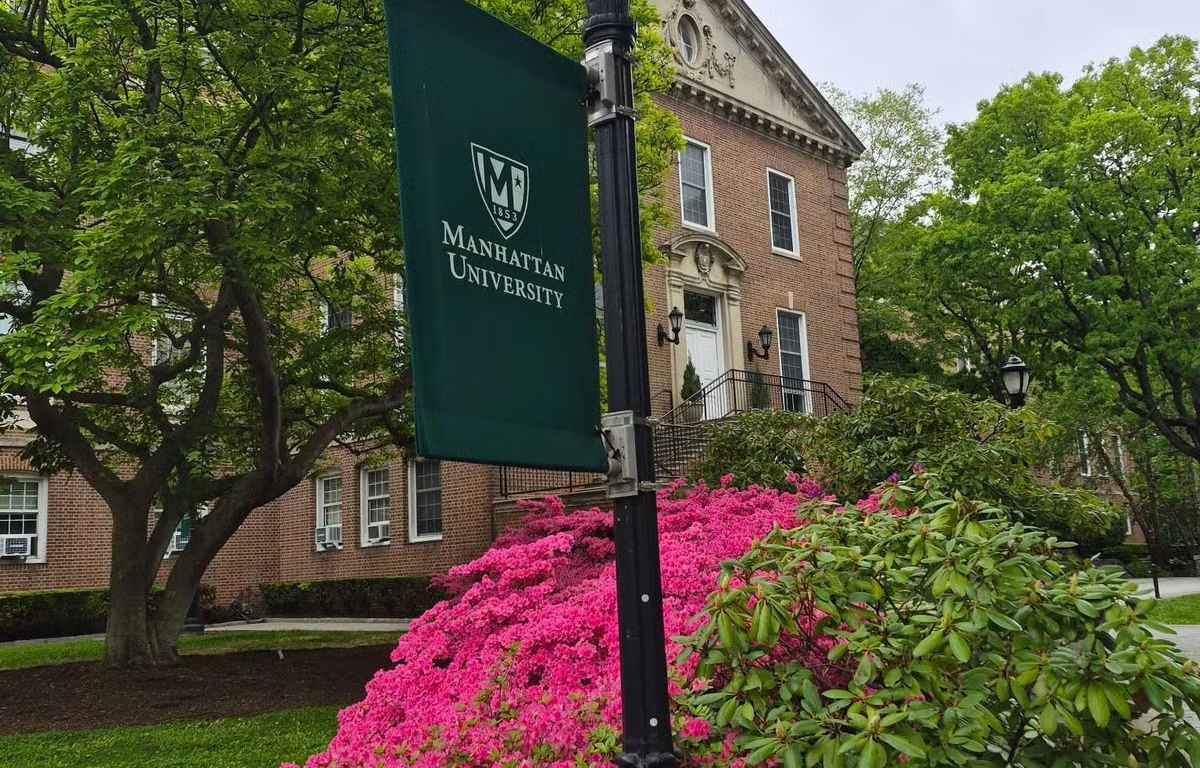
In a publication released by TIME on Aug. 25, the magazine shared an article titled “America’s Best Colleges of 2026-2027,” ranking Manhattan University (MU) 103 out of 500 institutions.
The rankings are based on statistics gathered from the Integrated Postsecondary Education Data System (IPEDS), which collects information annually from colleges and universities across the United States. TIME Magazine evaluates each university based on student outcomes, learning environment and attractiveness.
According to TIME, student outcomes, which carry the greatest weight in the rankings, measure “what students gain from attending an institution, measured after they leave it.” The ranking provides recognition for universities across the country and offers prospective students another way to compare institutions.
To better understand the significance of MU’s ranking, The Quadrangle spoke with Marcy Kelly, Ph.D., dean of the Kakos School of Arts and Sciences (KSAS), about recent developments at the university that may have contributed to the recognition. Now in her fifth year at MU, Kelly also shared her perspective on being part of the university community.
“I love being around the students… the faculty and our staff,” Kelly said.
Kelly emphasized the importance of creating an inclusive environment where faculty can help inspire and prepare students for their future careers. She explained that the relationships between students, faculty and staff contribute to the overall experience at MU.
“I want everybody to feel like they belong… every single faculty member got into their jobs because they want to help the next generation of scientists, writers, the health care professionals,” Kelly said.
Kelly also discussed the university’s recent merger of the School of Arts and the School of Science, which formed the Kakos School of Arts and Sciences. She highlighted what she believes is an admirable quality of the university: the effort faculty and staff put into providing students with a quality education while creating opportunities that span multiple disciplines.
“We try to enhance [the] scholarship and to bring it to the students,” Kelly said.
The KSAS merger has also led to the development of new academic opportunities and programs, giving students additional options to explore different areas of study.
“[A few] examples would be our new majors, computational neuroscience, data science, cybersecurity and integrated marketing communication,” Kelly said.
Kelly noted that MU’s recognition is also partly due to the work of vice president of enrollment management and marketing, Stephen Pugliese and his team, who have worked to communicate the opportunities and resources available to prospective students. These efforts are part of the university’s broader attempt to attract students and highlight what MU has to offer.
Admissions counselor Kelly Kennedy discussed the university’s efforts to broaden the experiences and backgrounds represented within its student body. Each admissions counselor is assigned to a specific region from which they recruit students, allowing the university to reach prospective students from different areas and backgrounds.
“We’re always looking to grow and be better every year,” Kennedy said. “Every year here [at MU], everybody’s trying to make it better to attract more people and bring in more to the community, whether that be more internships for students, more clubs, everyone’s always looking to improve.”
Kennedy also believes the university’s faculty, staff and students contribute to the sense of community that makes MU deserving of greater recognition.
“It’s really great to have MU mentioned, or promoted more because being a smaller school, not everybody really knows about MU,” Kennedy said. “But everybody that comes here loves it. I think it’s great to kind of get our name out more.”